
Max Mara’s Resort 2027 collection demonstrated that the future of European luxury in China depends less on heritage alone and more on meaningful cultural dialogue, presenting a wardrobe that translated Chinese design traditions through the house’s own language of tailoring.
Staged on 16 June at Shanghai’s Long Museum as part of Max Mara’s 75th anniversary celebrations, the collection carried an atmosphere of confident cosmopolitanism rather than nostalgia. Creative director Ian Griffiths explored the idea of “dynamic elegance”, positioning Shanghai as the ideal backdrop for a brand built around metropolitan women. Rather than abandoning the house’s familiar signatures, he expanded them. Precise tailoring, luxurious cashmere and the iconic camel coat remained central, while references to Chinese dress introduced a fresh rhythm to silhouettes that have long defined the Italian label.
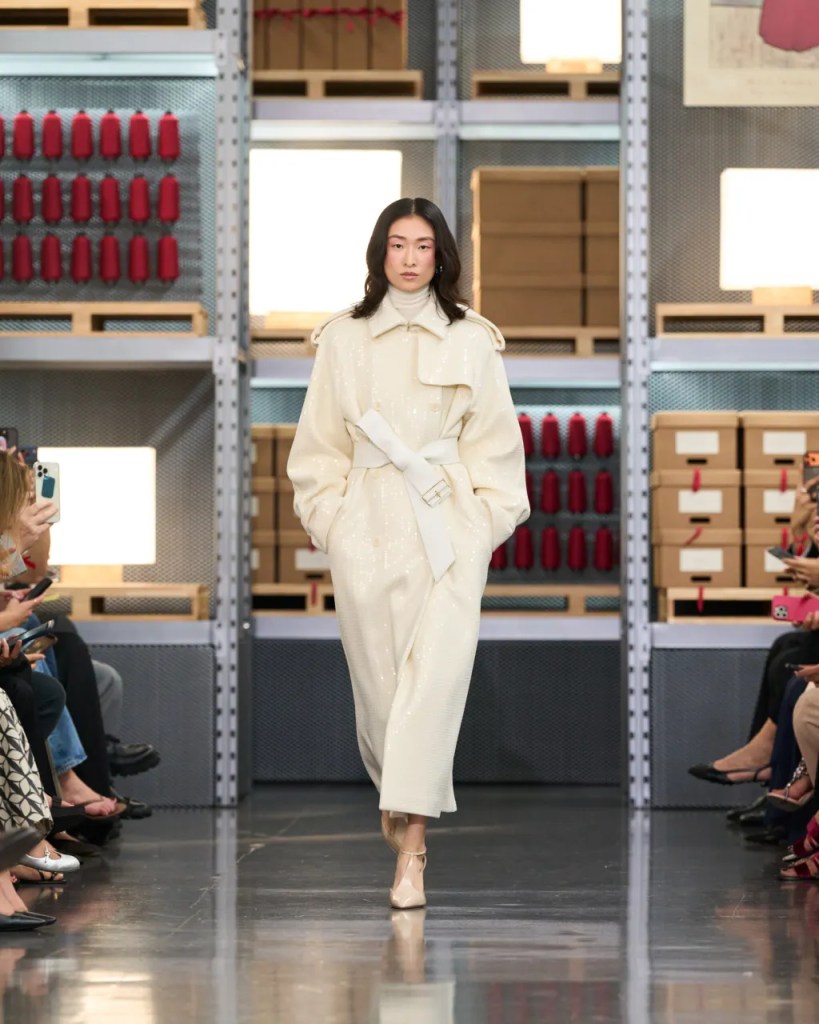
The runway unfolded inside the museum’s galleries, transformed into a vast archive inspired by Max Mara’s headquarters in Reggio Emilia and accompanying the opening of “The Max!”, an exhibition curated by Olivier Saillard celebrating the house’s history. The audience reflected the event’s international ambition. Michelle Yeoh, Katie Holmes, Eileen Gu, Maude Apatow, Nicky Hilton, Kathy Hilton, Heart Evangelista and Tina Leung were among the guests, underscoring Shanghai’s growing importance as a global fashion capital rather than simply a luxury market.
Several looks illustrated how carefully the collection balanced Italian restraint with Chinese references. High standing collars and side fastening jackets echoed the cheongsam without slipping into costume, while traditional pankou knot buttons appeared on softly tailored jackets and coats cut in Max Mara’s signature camel wool. One particularly striking ensemble paired cropped tailored trousers with a Chinese inspired jacket, allowing familiar construction to carry unfamiliar decorative codes. Elsewhere, an ivory sequinned trench belted in an obi style opened the show, immediately signalling that this would be an exploration of cultural exchange rather than historical recreation.
Colour provided another compelling narrative. Max Mara’s enduring palette of camel, cream and charcoal was punctuated by vivid crimson, a hue rich in Chinese symbolism. A scarlet sequinned cheongsam worn with leather opera gloves stood alongside relaxed red outerwear and softly structured cashmere separates, while graphic Bauhaus inspired knits, pencil skirts and sculptural tailoring reinforced Griffiths’ long standing fascination with modernist design. The closing look, a shimmering crimson slip dress beneath an oversized red coat, distilled the collection’s central idea that timeless house codes can absorb new cultural influences without losing their identity.
Critical reaction was largely positive, with commentators praising the sophistication of the cultural references and the restraint with which they were handled. Rather than treating Chinese motifs as decorative novelties, reviewers noted that Max Mara integrated them into the brand’s established vocabulary of practical luxury and impeccable tailoring. Many also observed that staging the anniversary show in Shanghai reflected a broader shift across the luxury industry. As Chinese consumers increasingly expect genuine cultural engagement rather than imported prestige, Max Mara’s collection suggested that relevance today comes through dialogue instead of simple localisation. It was less an exercise in reinvention than proof that one of Italy’s most enduring fashion houses can evolve while remaining unmistakably itself.