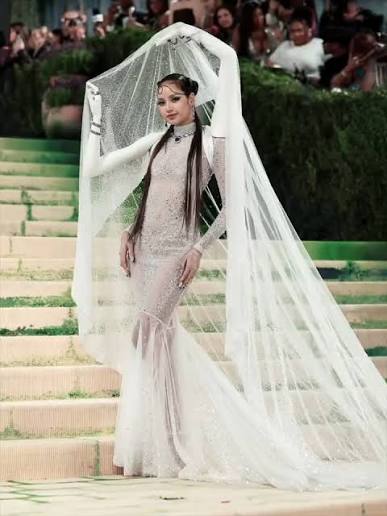
Lisa’s Met Gala appearance was visually arresting and conceptually ambitious, but it ultimately tipped into overload, where spectacle began to obscure silhouette and intent.
The look was widely described in fashion coverage as a sculptural couture ensemble built around exaggerated hand motifs that extended across the body like an architectural intervention. The construction appeared highly engineered, with a fitted base layer serving as a canvas for dimensional appliqué and sculptural detailing. The palette remained controlled to keep focus on form rather than colour. Reports from fashion outlets attributed the look to Robert Wun, with jewellery kept minimal to avoid competing with the garment’s built in drama. Footwear was largely concealed beneath the length and structure of the piece, reinforcing the sense that the outfit was designed as a singular object rather than a separable styling exercise.
The intention behind the look seemed rooted in transformation. Rather than presenting a conventional red carpet silhouette, Lisa appeared to lean into the idea of the body as a site for surrealist interruption, where familiar human forms are abstracted into fashion objecthood. In the context of a Met Gala theme centred on fashion as art, the look positioned itself firmly within the language of wearable sculpture. It was less about elegance in a traditional sense and more about visual impact, narrative tension and the destabilisation of proportion.
Where the look succeeds is in its commitment to concept. It is rare to see a celebrity so fully surrender the recognisable language of red carpet dressing in favour of something closer to installation art. Fashion commentators broadly acknowledged this ambition, noting that the piece stood out in a sea of gowns that, while technically impressive, remained anchored in conventional glamour codes. There was recognition that Lisa was not attempting to be merely “best dressed” but instead to inhabit a more experimental register.
However, the same ambition also creates its central problem. Several critics suggested that the density of detailing competed with the clarity of the silhouette, resulting in a visual field that felt congested rather than refined. When every surface is activated, the eye struggles to find hierarchy, and the garment risks reading as an accumulation of ideas rather than a resolved composition. In that sense, the look edges towards excess without the editing that typically distinguishes couture from costume.
Ultimately, Lisa’s Met Gala appearance sits in the productive tension between innovation and overstatement. It is a look that demands attention and rewards analysis, but it also raises a familiar question in contemporary red carpet dressing: when everything is a statement, how do you decide what the statement actually is.