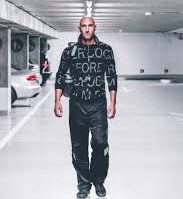
Martine Rose has always been a master of controlled contradiction. Her spring summer 2026 collection, shown in a dimly lit warehouse on the outskirts of London, reasserted her uncanny ability to warp the codes of masculinity, suburbia and sportswear into something at once eerie and magnetic. This season, the touchstones were clear: 90s leisurewear, domestic British drudgery, and hints of middle-management boredom, all pushed into a surreal realm of proportion and styling.
Ties hung low and wide over shiny nylon shirts, the kind once worn to company picnics. Trousers ballooned strangely at the hips or were cinched almost uncomfortably high, evoking something both awkward and erotic. Office sandals were paired with sheer socks and aggressively pointed toenails. It was funny, but also deeply uncomfortable. Rose’s silhouettes always seem like a dare — to accept ugliness, oddness, and truth.
What might look like a pastiche at first glance reveals, on closer inspection, a profound study of power, vulnerability and class. A chalk-striped blazer with distorted lapels becomes a commentary on how fashion codes signal ambition or failure. The palette was sickly and smart: pale greys, ochres, bruised lilacs, the colours of a carpeted waiting room or a chain pub’s curry special.
Precision chaos and the male gaze reversed
Hair, always a semiotic playground for Rose, was exaggerated this season. Slicked, sculpted, or curled into absurd helmet-like crowns, it took on the role of armor and caricature. Her casting was, as ever, a lesson in narrative — her models looked like the men one might see at a petrol station, on a night bus, or behind a service desk, reframed as protagonists in their own absurdist theatre.
What distinguishes Rose from her imitators is the rigour of her subversion. These aren’t cheap provocations. Every ill-fitting trouser and deliberately misaligned jacket is part of a finely tuned system of semiotics. She doesn’t simply reference culture — she refracts it. There’s an unmistakable affection for her source material, even as she dismantles it. This season’s lookbook and soundtrack (an eerie reworking of 80s pop) only underlined the atmosphere: nothing is quite right, but everything is precisely where she wants it.
Spring summer 2026 was less about invention than calibration. Rose isn’t chasing novelty. She’s building a vocabulary of British discomfort, one that has never felt more compelling.