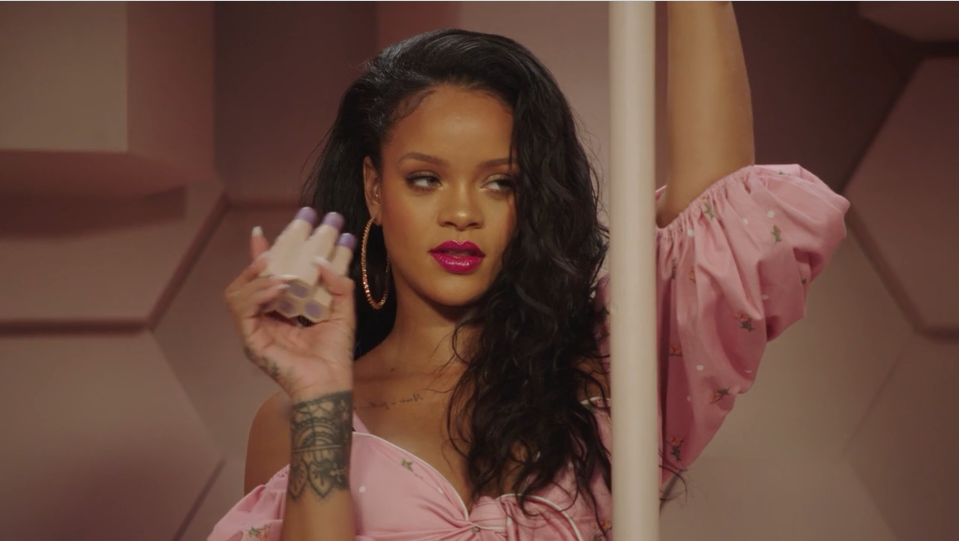
It began with foundation. When Fenty Beauty launched in 2017 with a then-revolutionary 40 shades of foundation (now 50+), it wasn’t just a makeup line—it was a cultural intervention. At a time when most major cosmetics brands had long ignored the complexity of darker skin tones, Rihanna’s insistence on full-spectrum inclusivity sent shockwaves through the industry. The result? An immediate sell-out, a billion-dollar valuation, and what industry insiders dubbed “The Fenty Effect”—a seismic shift in beauty standards that forced other brands to diversify or be called out.
More than product alone, it was the marketing: Rihanna made every woman feel seen. Campaigns showcased not just a range of skin tones, but body types, ethnicities, and gender expressions too. Her message was clear: beauty wasn’t aspirational; it was already yours.
Savage X Fenty: lingerie for every body
Next came lingerie. With Savage X Fenty, launched in 2018, Rihanna once again challenged a stale industry—in this case, Victoria’s Secret’s reign of exclusion and fantasy. Savage wasn’t about angels. It was about real bodies in motion, real desire, and unapologetic sensuality. The annual Savage X Fenty runway shows became cultural events, blending high fashion, performance, and casting that celebrated trans models, plus-size dancers, and women of all identities.
The impact? A lingerie revolution. Savage became the new gold standard for inclusivity, not through tokenism but through vision. Rihanna’s presence was magnetic—she wasn’t just the creative director, she was the muse, the CEO, and the stylistic oracle.
Fenty fashion: the LVMH experiment
In 2019, Rihanna achieved something no other Black woman had done: she launched a fashion line under the LVMH umbrella, joining the likes of Dior and Louis Vuitton. Simply called Fenty, the brand offered modern tailoring, sharp suiting, and architectural silhouettes at a luxury price point. For a time, it felt like a thrilling evolution of Rihanna’s style—minimalist but bold, grounded in streetwear, and unafraid to rewrite the codes of luxury.
But in early 2021, LVMH announced that Fenty fashion would be put “on hold.” Though neither party declared it a failure, the brand struggled to build the same momentum as Rihanna’s beauty and lingerie lines. Perhaps the pace of high fashion—seasonal, slow, Eurocentric—was out of step with her lightning-fast, direct-to-consumer instincts. Perhaps the world wasn’t ready for a fashion house led by a Black woman with no formal training and no interest in convention.
Legacy: a new blueprint
What’s undeniable is this: Rihanna has redrawn the boundaries of what celebrity fashion can be. Not just a licensed fragrance or a capsule collection, but an empire built on vision, ownership, and a profound connection with people historically ignored by fashion’s gatekeepers.
She didn’t enter the industry to fit in—she came to tear the mold apart. And in doing so, she’s made space for something better, bolder, and far more inclusive. Whether or not Fenty fashion returns, Rihanna’s legacy as a style revolutionary is already sewn into the seams of the industry.