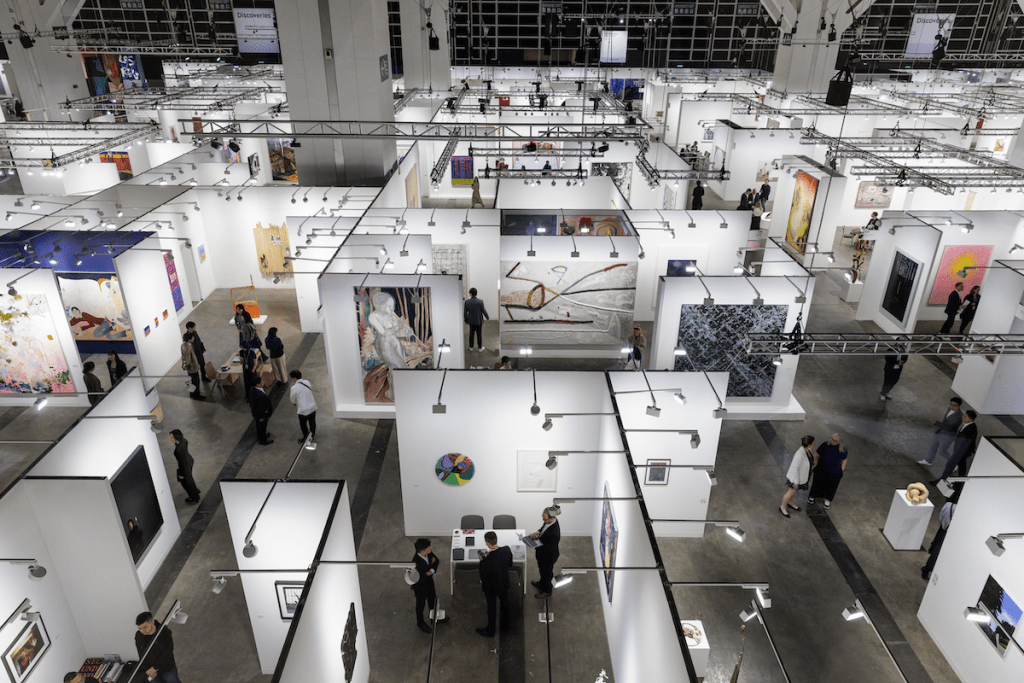
At 5 p.m. sharp on VIP preview day, the doors to Art Basel Hong Kong opened—not to the public, but to an elite group of collectors, gallerists, and curators flown in from New York, London, Seoul, Zurich, and beyond. Within minutes, key works had already sold. The energy was focused and transactional, as usual—but this year, the buying was quicker, and the clientele more Asian than ever before.
Serious Sales, Quiet Confidence
The fair’s private preview, held at the Hong Kong Convention and Exhibition Centre, is structured for efficiency. Major galleries arrive with committed buyers already in discussion. Transactions are often concluded within hours, sometimes minutes. At Hauser & Wirth, Mark Bradford’s large-scale abstract canvas—priced at over $3 million—sold almost immediately to an established Hong Kong-based collector. A Jenny Holzer LED piece, also at the booth, was placed with a Singaporean foundation by mid-evening.
Over at Gagosian, two paintings by Albert Oehlen were spoken for before 6 p.m., both going to mainland Chinese collectors who had previewed the works privately ahead of the fair. David Zwirner confirmed the sale of a Neo Rauch canvas by 6:30 p.m., with gallery staff noting strong interest from younger Korean collectors.
But not everything was headline-worthy in price. Several galleries noted that works under $500,000 were moving more steadily than eight-figure showpieces. At Sadie Coles HQ, Sarah Lucas’s sculpture in bronze and neon was snapped up by a Bangkok collector, while Sherrie Levine’s editioned mirrors sold to two different buyers from Seoul and Jakarta respectively.
The Crowd Behind the Curtain
The composition of the crowd is shifting. While the fair retains its cachet among European and American collectors, the emphasis has clearly moved toward Asia. Several major buyers—quiet regulars rather than celebrity names—arrived from Jakarta, Taipei, and Kuala Lumpur, often accompanied by art advisors and multilingual assistants. Mandarin, Cantonese, and Korean were as commonly spoken as English.
Institutional presence was strong. Curators from M+ and UCCA were seen touring booths methodically. Representatives from the Louvre Abu Dhabi and LACMA also attended, though less visibly active in purchasing. One gallerist noted interest from a Middle Eastern museum in a Toyin Ojih Odutola drawing, but declined to confirm if the work had been reserved.
Champagne circulated, but not excessively. This is not a party—it’s a market. Most of the conversations were transactional, often whispered, often short. Gallerists tracked sales via shared iPad spreadsheets; logistics teams waited in the wings to arrange shipping within minutes of a deal closing.
No celebrities were spotted during the first two hours, though whispers of a private walkthrough with a major K-pop star made their way through the crowd near the end of the evening.
By the close of the night, the tone was quietly optimistic. Amid ongoing global uncertainty, Art Basel Hong Kong’s private preview reaffirmed its place as one of the most decisive commercial moments on the art world calendar. Deals were done, relationships confirmed, and for those on the inside, the fair was already a success—before the public even stepped inside.